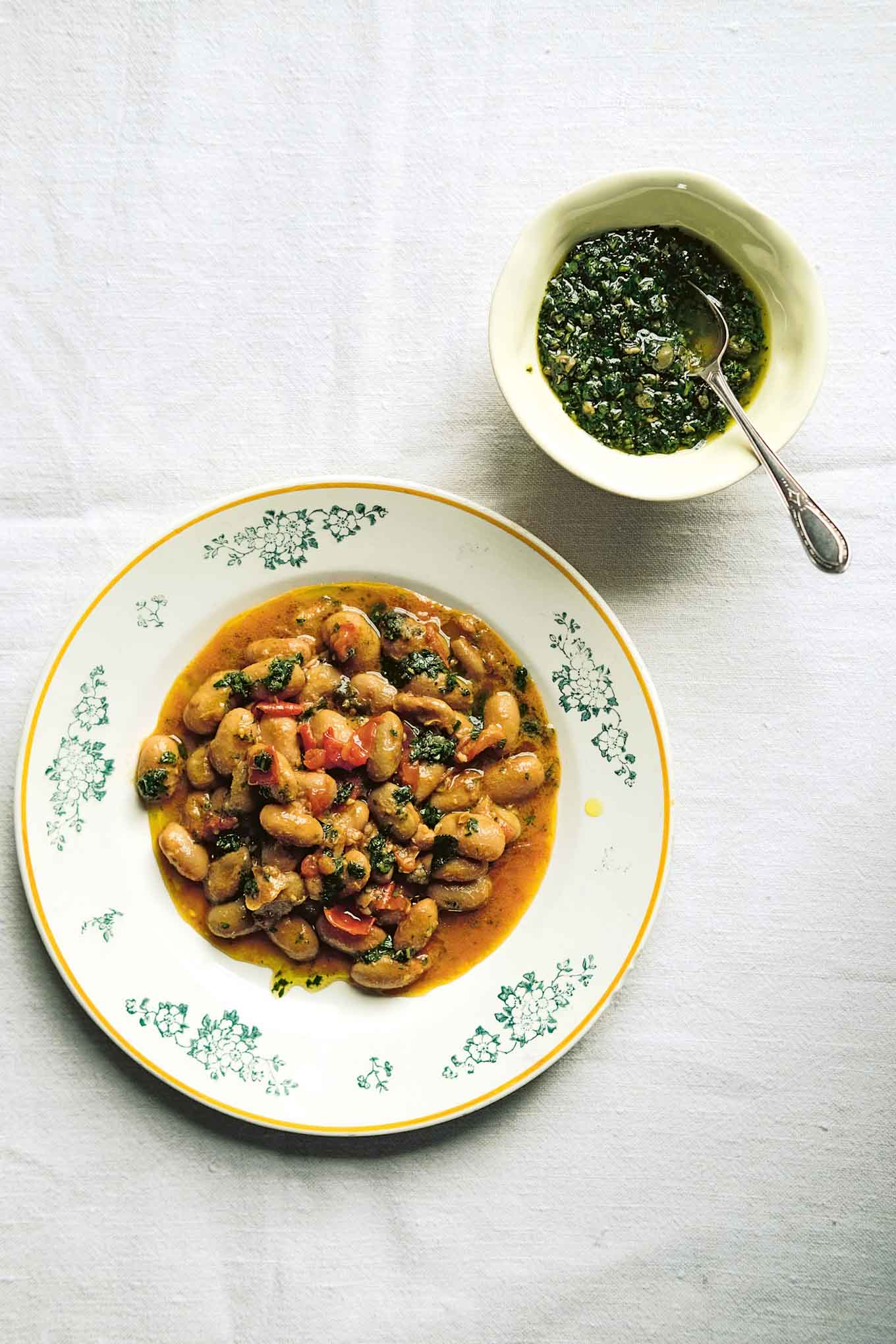
Words by Olivia Cavalli. Image by Sophie Davidson.
Fresh borlotti also go by the names cranberry beans, October beans and Fall beans, the latter an American term for the time of year that they’ll pop up in the market.
The beauty of fresh borlotti is not just in their mottled, pur ple pods or shiny speckled skins but in the fact that there’s no need to soak them before cooking. Slip them from their jackets and slide them into the pan and they plump up in a matter of minutes, no forward thinking required. Anyone who’s cooked with them before will have experienced the initial disappointment of watching that eye-catching beauty simmer away in a puff of steam, from marbled pink to dreary brown, as if some sort of spell had been cast upon them. They are more than their looks though and what’s lost in appearance is made up for in taste – creamy and nutty and full of opportunity. Here I’ve given a simple braising method that can be served as is, anointed with your best olive oil or used as a base for other things.
The recipe is from Stagioni: Contemporary Italian Cooking to Celebrate the Seasons. If you cook seasonally and like straightforward Italian food, the book is worth a look.
Braised Borlotti with Salsa Verde
Ingredients
- 2 fat garlic cloves
- 240 ml (8fl oz) extra virgin olive oil, plus more for serving
- 2-3 large tomatoes
- handful of sage leaves, 2 sprigs of rosemary or both
- 1 kg (2lb 4oz) fresh borlotti beans in their pods, approx. 500–550g/1¼lb raw podded beans or approx. 300g/10½oz dried beans (soaked overnight)
- fine salt
- salsa verde, to serve
Instructions
- Bash the garlic cloves with the side of a knife and peel off the skin. Keeping them whole, put in a medium pan with the oil and heat on a medium flame for 5–8 minutes until very lightly golden and fragrant.
- Dice the tomatoes up roughly and add to the pan. Tear the sage leaves roughly and add them too, then stir and cook for a further 5 minutes.
- Add the borlotti beans, then pour enough water in to just cover them. Bring to the boil then immediately reduce to a medium simmer and leave to cook, uncovered, for 75–90 minutes, topping up with water whenever needed so the beans are always just covered. The time varies depending on the freshness of the beans (dried tend to need longer) so just keep tasting them. They should be lovely and soft but retaining their shape with a few bursting from their skins, on the edge of mushy.
- At the end of cooking time, the water and oil should have thickened and become saucy. Season with around 1 tsp of salt, or to taste, and stir through a glug of extra virgin olive oil before serving with salsa verde.
Notes
Salsa Verde
Ingredients
- 20 g (¾ oz) parsley
- large handful of rocket, basil or mint leaves
- 3 anchovies packed in oil
- 1-2 tsp capers, optional
- about 4 tbsp extra virgin olive oil
- 1½ tbsp red wine vinegar
- fine salt, optional
Instructions
- Remove any coarse stalks from the parsley. Place the parsley, rocket or herbs on a chopping board and use a sharp knife to chop very finely. Put the anchovies on top and chop until well-blended, then repeat with the capers, if using. Transfer to a bowl and whisk in the oil and vinegar. Taste, adding a touch of salt or a little more vinegar, if desired. It should be a thick-ish but drizzle-able sauce.
Extracted from: Stagioni: Contemporary Italian Cooking to Celebrate the Seasons by Olivia Cavalli (Pavilion, HarperCollins Publishers). Image by Sophie Davidson.